
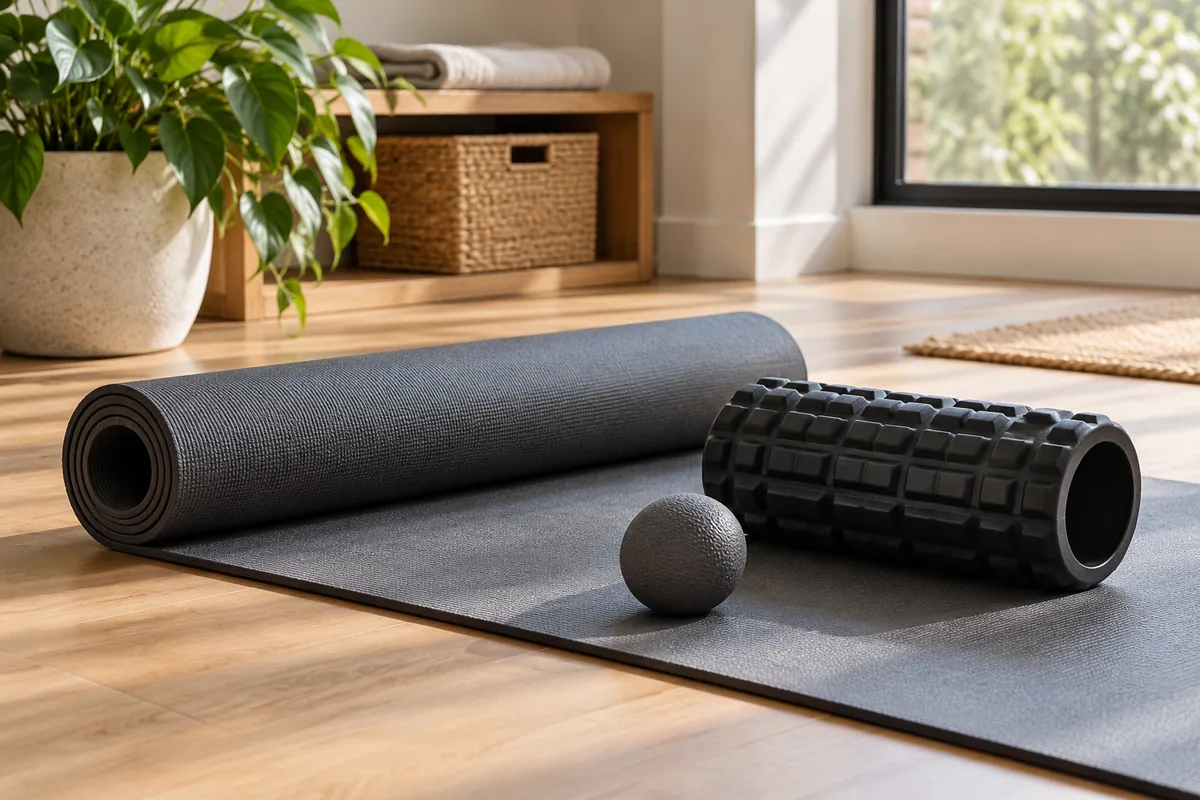
A piece of equipment that fits through the door may still be wrong for the room. A useful home-gym plan accounts for the space around movement, the combined weight of equipment and users, and the noise that travels through a building. Make a paper or taped layout before ordering, then check the manufacturer’s instructions for each actual product.
Measure the room and the route
Record floor length and width, ceiling height and the position of doors, windows, outlets, radiators and low fixtures. Measure stair turns, lifts and doorways on the delivery route. A machine may arrive partly assembled or in a box larger than its assembled footprint, so ask for packaging dimensions and weight as well as the equipment dimensions.
Draw the full movement envelope: the reach of an arm holding a dumbbell, a bench’s adjustment path, or the clearance to get on and off a machine. Leave a clear route to the door and keep emergency exits accessible. A mat or tape outline can reveal a conflict with a door swing that a product photo misses. Check the manufacturer’s specified clearance if it provides one; do not replace it with a generic rule of thumb.
Account for weight and the floor
Add the equipment, all plates, accessories and people who will be in the area at once. A pair of adjustable dumbbells, its trays and a stand can weigh much more than the maximum value printed on one handle. A loaded rack concentrates weight at its contact points. Floor finish, subfloor and building structure all matter, as do dynamic forces from movement or dropped weights.
A rubber mat may protect a finish and reduce some surface noise, but it does not prove that the floor can support the load or eliminate structural vibration. For a heavy installation or uncertainty about a floor, ask the building owner or a qualified structural professional before moving equipment in. Follow lease, building and insurer requirements where relevant. Do not estimate structural capacity from room size alone.
Plan for noise and neighbors
Distinguish airborne sounds, such as a motor or music, from impact and vibration transmitted into floors or walls. The latter can travel even when a room sounds quiet to its occupant. Equipment selection and use matter: controlled placement of weights, avoiding drops, stable assembly and maintenance can reduce avoidable disturbances. A mat is one part of a plan, not a soundproofing guarantee.
Ask neighbors or building management about quiet hours and acceptable equipment. Consider the timing of sessions and locate equipment away from shared walls when possible. A product’s published noise claim is not a measurement in your building: floor construction, speed, load and mounting change the result. If buying a machine, check return and delivery terms before assuming it will suit the space.
Make a practical checklist
- Measure the assembled footprint, use clearance, height and delivery path.
- List total stored and operating weight, including people and accessories.
- Check floor suitability, building rules and professional advice where needed.
- Plan ventilation, lighting, a suitable electrical outlet and a safe cable route.
- Allocate storage for loose plates, collars, mats and cleaning supplies.
Keep equipment away from children when unattended and follow each maker’s anchoring and placement instructions. A storage plan should prevent heavy objects from rolling or obstructing exits. Adjustable equipment should be kept together with its own base and instructions.
Choose the setup in stages
Start by mapping the movements you actually expect to do. Then compare one or two equipment arrangements, including a low-equipment option. Check how each would be moved, stored and maintained. You can add equipment later once you know how the area functions, rather than filling every available square foot immediately.
Finally, record model and serial information and check the CPSC recall database for U.S. purchases and the relevant authority in other countries. The CPSC’s adjustable dumbbell notice illustrates why a compact product’s mechanical safety matters as much as its footprint. Search results change over time and are not a safety certification.
Make an allowance for ordinary use outside exercise time as well. A folding machine still needs a secure parked position, while a bench may block a cupboard when adjusted. Photograph the proposed layout and measure it again after delivery. Recheck clearance when adding a new attachment or moving equipment; an initially workable room can become crowded as the collection grows.