
Start with the activity you can repeat
Indoor cycling and rowing can both provide aerobic activity, but they make different demands on space, setup, and movement. Neither machine is automatically the better choice for everyone. The useful question is which activity fits your body, home, schedule, and preferences well enough to use regularly.
U.S. adult guidelines recommend at least 150 minutes of moderate aerobic activity per week, or 75 minutes of vigorous activity, or an equivalent combination, plus muscle-strengthening activity on at least two days. Actual intensity depends on effort and the person, not simply which machine is selected.
Compare the movement
On a stationary bike, you pedal from a seated position, with the setup and posture varying by bike style. An indoor rower uses a sliding seat and coordinates a leg drive, body swing, and arm pull. Rowing has a technique sequence to learn as well as a need for comfortable access to the seat and foot supports. Concept2 provides a technique demonstration for its RowErg.
Try both where possible. Notice whether you can adjust the bike to a comfortable position, reach the controls, and get on and off with confidence. On a rower, check the slide, handle path, foot supports, and your ability to move through a comfortable range. A suitable machine is one that works for your circumstances, not the one with the most impressive specifications.
Measure the real footprint
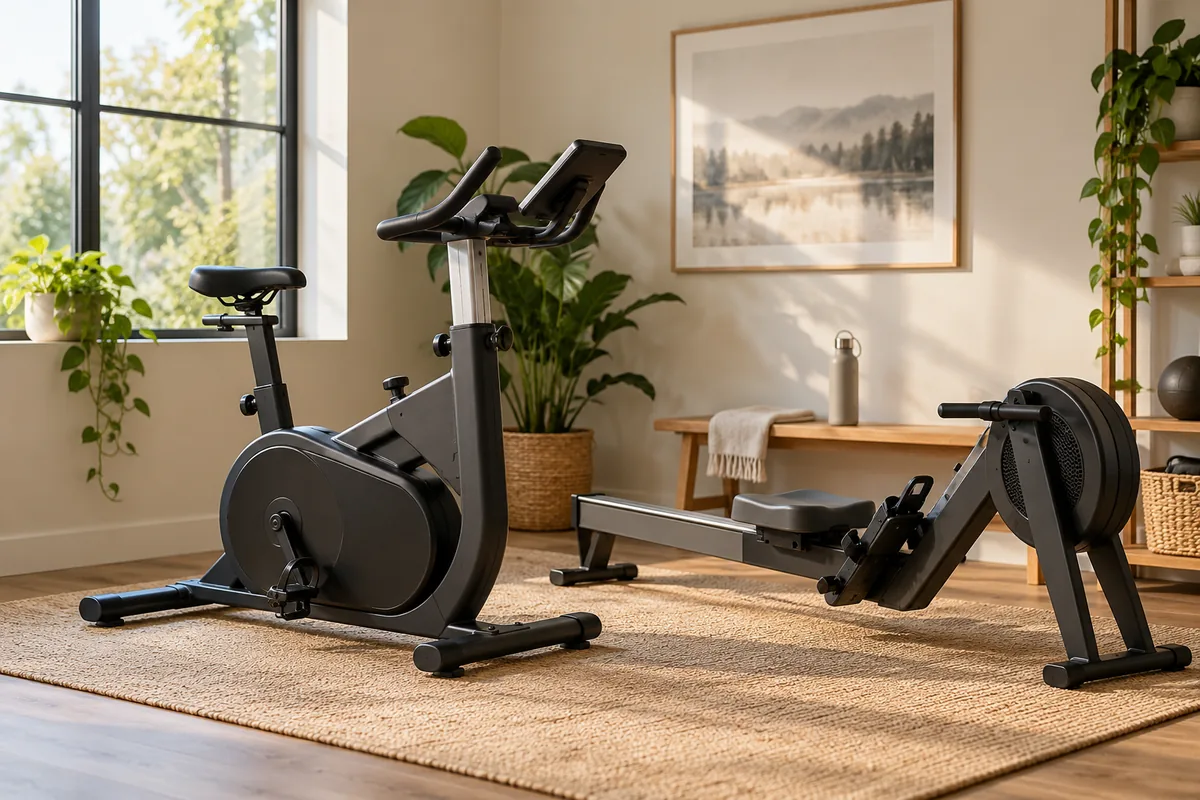
A bike often has a relatively compact floor footprint, while a rowing rail may require a longer clear area. Exact dimensions vary widely. Measure the specific machine rather than relying on a category label, and include clearance for movement, mounting, ventilation, and access to controls. Check ceiling height if storage involves standing a rower upright.
- Floor space: Measure the machine and usable clearance, not just the packaged box.
- Storage: Check whether moving, folding, or standing the model is practical for you.
- Noise: Resistance mechanisms and surroundings vary; consider shared walls and floors.
- Access: Check entry, exit, adjustments, and the room available around the machine.
Consider how the machine reaches its destination, including stairs, doorways, assembled weight, and any help needed for delivery. A machine stored behind furniture may be less convenient than a smaller or more accessible alternative.
Consider the experience and upkeep
Fans, flywheels, chains, belts, and contact with flooring can sound different. Manufacturer specifications rarely predict the exact noise heard in an apartment, so a demonstration can help. Mats may protect the floor, but do not assume one will eliminate vibration. Check the equipment manual for floor requirements and cleaning or maintenance instructions.
A console, subscription, or connected service may be appealing, but it is useful to know what functions work without it and whether any recurring fees apply before buying. Controls should be readable and reachable. Compare warranties and available parts for the specific model and region, and keep setup instructions accessible.
Try an ordinary session
A short trial at a comfortable effort can reveal whether the seat, grips, foot supports, and movement suit you. The CDC’s talk test is a rough intensity guide: at moderate effort you can generally talk but not sing. The same setting may feel different to another user, and a monitor estimate is not a diagnosis.
Consider how the activity fits with other movement you enjoy and with separate muscle-strengthening work. If you have symptoms, a health condition, recent injury, or uncertainty about exercise, seek suitable professional advice. Stop if you feel pain or unwell. Either machine can be a practical choice; buying neither and using a local facility or another accessible activity is also a reasonable option.
Compare total ownership
The purchase itself is only part of the decision. Consider delivery, assembly, maintenance supplies, replacement parts, and any optional digital services. A used machine may be less expensive but needs an inspection for wear and a check of model-specific safety notices. In a shared household, make sure other users can adjust the equipment and put it away safely. A trial at a gym or community facility can also reveal whether you enjoy the motion before you reserve floor space at home. These practical costs and constraints differ by model and location.